2026-05-05
“It’s not enough to say you save time or money” – Nordic companies on insights from Health3-2-1
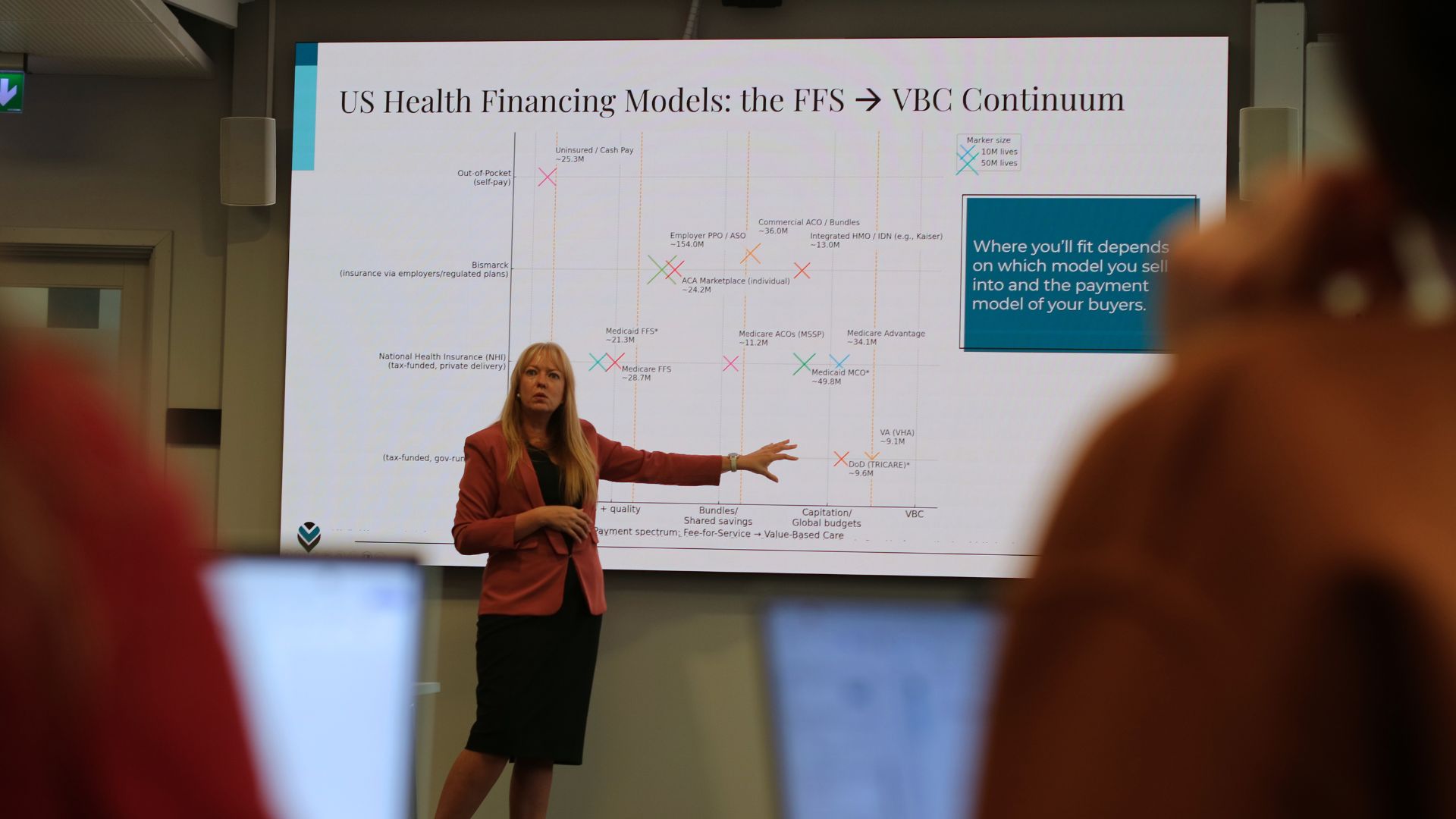
How do you actually enter the U.S. healthcare market and start generating revenue?
That question was at the center when Swedish and Finnish healthtech companies gathered for a workshop within the EU-funded program Health3-2-1, led by Elizabeth Jennings, Managing Partner at Venture Atlas Labs. Over one and a half days, the companies worked on their own cases and focused on a question that is often underestimated: how value actually translates into revenue in the U.S. healthcare system.
For many companies, the U.S. is seen as the obvious growth market. The potential is significant and demand is there. At the same time, experience shows that many fail, not because the technology is lacking, but because they underestimate how the market actually works from an economic perspective.
The rules are not the same in the U.S.
A key insight from the workshop was that what creates value in the Nordics does not automatically lead to revenue in the U.S. Many Nordic companies build their offerings around efficiency gains and cost savings. In the U.S., the logic is often different, where reimbursement is more strongly driven by volume.
As a result, an offering that works well in the home market does not always fit, and it can be difficult to get paid, even when the benefits are clear.
Andreas Macura, COO at AlgoDx, highlights willingness to pay as a central issue.
- The most critical question for us comes down to something quite fundamental: who is actually going to pay for our product. In the U.S., this often looks completely different compared to Europe, and that is something Elizabeth Jennings made very clear during the workshop, says Macura.
More than one market
Another important part of the workshop was to nuance the view of the U.S. as a single market. In practice, it consists of several parallel systems that function in different ways. Incentives differ, reimbursement models vary, and decisions are made at different levels.
This means that the path to revenue is not the same everywhere. Where you enter and how you position yourself makes a significant difference.
- The market is vast and fragmented. There are many stakeholders, many decision pathways, and many levels where an offering needs to be anchored. It is not enough to approach a hospital directly and present a price, you need to understand the entire structure behind the decisions, says Macura.
Value is not enough
In this context the value proposition becomes more complex than in many other markets. It is not enough to demonstrate that a solution saves time or money. What matters is who actually captures the benefit, and whether that person also has the mandate and budget to make a decision.
Annica Jämtén Ericsson, COO at Stratipath, describes how the workshop helped connect several pieces that had previously felt fragmented. At the same time, it reinforced how challenging it is to enter the U.S. market.
- We already had some understanding of parts of this, but what really stood out was how important it is to be extremely specific in your value proposition. It is not enough to say you save time or money. You need to show exactly for whom the value is created, says Ericsson.
She also points out what happens when this is not sufficiently clear. An offering may be perceived as relevant in one part of the system, while at the same time creating costs or reducing revenue in another. In that case, the deal falls through, even if the solution itself is strong.
- There is a risk that you instead shift costs or reduce revenue in another part of the system, and then the offering is not perceived as valuable by the stakeholder you are speaking to. That was a perspective Elizabeth Jennings illustrated very clearly.
More paths to revenue than the obvious ones
The workshop also showed that many companies get stuck in a relatively narrow view of the market, where the focus often ends up on traditional reimbursement models. It is a natural entry point, but it can also limit how companies see their opportunities.
- There’s an overestimation that reimbursement is the way to succeed in the market or even to start generating revenue, says Elizabeth Jennings.
In practice, there are more entry points, not least in parts of the system where compensation is linked to outcomes and efficiency. These opportunities are established, but are still underutilized by new entrants.
At the same time, they require a deeper understanding of how incentives are actually aligned. In many cases, they pull in different directions, which means that an offering can be perceived as valuable in one context but lose relevance in another.
From insight to action
Unlike more theoretical programs, the workshop was designed to directly connect insights to the participants’ own decisions.
The focus was on concrete situations the companies actually face: which stakeholders they engage with, how to interpret signals from the market, and how to build their pathway into the U.S.
For Andreas Macura at AlgoDx, this means moving forward with a more targeted analysis of their own position.
- For us, the next step is to go deeper into our own case. We need to ensure that the benefits we highlight are relevant for the right stakeholder, and that the person we are engaging with also has the mandate and budget to act. That was one of the most important insights from the workshop, says Macura.
At the same time, he points to the importance of timing.
- We have already made the decision to enter the U.S. and have come some way along that path, so much of what was discussed during these days feels familiar. At the same time, it is clear that we would have benefited greatly from several of these insights earlier in the process.
Different companies, different needs
The participants were at different stages of their U.S. expansion, which also influenced how they absorbed the content. For some, it was about building an initial structure and avoiding common mistakes. For others, it was about refining and adjusting an already initiated strategy.
Emma Höglund, CEO at Neobiomics, describes how the workshop built on previous work.
- We have been part of the Health3-2-1 program and gained a lot from it, particularly around reimbursement and market access. I have heard Elizabeth Jennings before, but this time she went much deeper, which suited us well since we have had time during the program to analyze our own situation in more detail.
As understanding deepens, perspectives also shift. What previously appeared as isolated challenges becomes part of a broader context, where both the complexity and the opportunities become clearer.
- That meant the content landed differently. At the same time, the complexity of the U.S. market becomes very clear, but so do the opportunities. That balance is what makes it so interesting, says Höglund.
When multiple logics collide
For Emma Höglund and Neobiomics, the workshop has provided a more nuanced view of the path into the U.S. It is not about a single decision, but about several components that need to work together, such as regulatory considerations and who you actually sell to.
- During the program, we have primarily reassessed how we view regulatory questions and market access, meaning who we actually sell to and how the reimbursement model works. That has been very valuable, says Höglund.
At the same time, it becomes clear that the strategy needs to function across multiple layers. A clear offering is not enough if it does not fit into how the healthcare system is organized in practice.
- Our current direction is to sell directly to hospitals within certain segments, but that requires a very clear value proposition and a strong value story. At the same time, we see that in practice you often need to relate to structures such as accountable care organizations in order to gain traction.
In Neobiomics’ case, there is also an additional layer of complexity linked to pediatrics, where the conditions differ from other parts of healthcare, particularly in more specialized areas. This means that some uncertainties still remain.
What becomes clear is that the path into the U.S. is rarely linear. It requires multiple elements to work simultaneously, and that companies are prepared to reassess both their position and their strategy along the way.
Swecare skapar mötesplatser där den svenska life science-sektorn kan stärka sina internationella relationer. Vi vill bidra till ökad export av svenska produkter, tjänster och kunskaper inom hälsoområdet.